---
title: "Running Training Load Analysis: CTL, ATL and TSB · Runima"
description: "Track your running training load, balance easy and hard effort, and plan next week's distance. Understand CTL, ATL and TSB with clear examples."
canonical_url: "https://runima.fit/features/training-load"
meta:
"og:description": "Track your running training load, balance easy and hard effort, and plan next week's distance. Understand CTL, ATL and TSB with clear examples."
"og:image": "https://runima.fit/og-image.jpg"
"og:image:height": "630"
"og:image:type": image/jpeg
"og:image:width": "1200"
"og:title": "Running Training Load Analysis: CTL, ATL and TSB"
"twitter:image": "https://runima.fit/og-image.jpg"
---
> Index of every page on this site: [llms.txt](https://runima.fit/llms.txt)
Training load
# Understand your running training load
Weekly distance shows how far you ran, but not how hard you worked. Runima tracks training load and effort over time to help you plan your next week.
[**Start free**](https://runima.fit/signup) [**See how training load is calculated**](https://runima.fit/docs/metrics/training-load)
Free during early access · No credit card
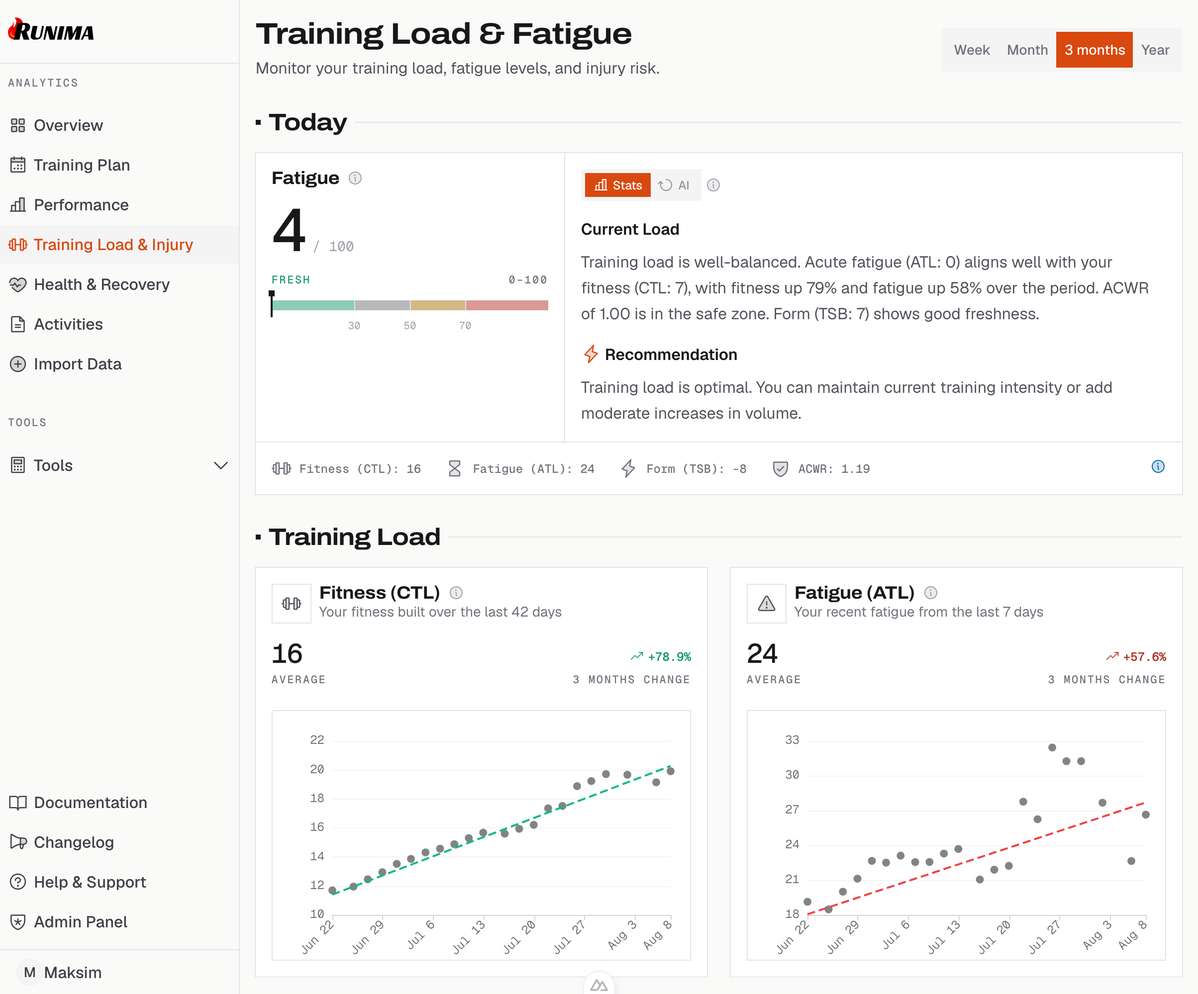
## What fitness, fatigue and form mean
Training load combines how long and how hard you run. Runima estimates each run's effort as running load. A Banister-style model uses these scores to track three measures:
- **Chronic Training Load (CTL), often called fitness**
- Your longer-term load, using a 42-day timescale.
- **Acute Training Load (ATL), often called fatigue**
- Your recent load, using a 7-day timescale.
- **Training Stress Balance (TSB), often called form**
- CTL minus ATL: how your recent load compares with your longer-term load.
These scores estimate training stress, not your fitness or recovery. Compare them with [**changes in your running performance**](https://runima.fit/features/performance-analysis) and how you feel.
Example data · Not from real runners
## Compare recent training with your usual load
See when your recent training load rises above or falls below your longer-term load. A negative TSB means recent load is higher; a positive TSB means it is lower.
### Training load balance (TSB)
Form: longer-term load minus recent load
-8.1
Latest sample value
- Longer-term load · CTL
- 41.0
- Recent load · ATL
- 49.1
-12 -9 -6 -3 0 3 6 Aug 3 Aug 10 Aug 17 Aug 24 Aug 31 Sep 7 Sep 13
This score cannot tell you whether you are recovered, ready to race or at risk of injury. Use it alongside your training history and how you feel.
Example data · Not from real runners
## See how much running is easy or hard
See how much time you spend at easy, moderate and hard effort. Compare weeks to check whether your running matches your training plan.
### Time in Zones
Easy, grey and hard running time
2.00
Polarization index
Easy
Z1-2
82%
Grey
Z3
8%
Hard
Z4-5
10%
**Polarized**
Most time is easy and hard sessions are truly hard, with little in the grey zone.
hours
0 1 2 3 4 Aug 3 Aug 10 Aug 17 Aug 24
Easy (Z1-2)
Grey (Z3)
Hard (Z4-5)
This example includes 14 of 18 runs. Only runs with heart-rate recordings in FIT files appear here; summary CSV files cannot show time in each zone. Your heart-rate zone settings affect the split. No single split suits every runner.
Example data · Not from real runners
## Plan next week from your recent training
See a suggested weekly distance range based on your recent runs. Compare it with your plan and your longest recent run.
### Next 7 Days
A planning example, not a proven safe distance.
**build**
Weekly volume
40–44km
Session-distance reference
13.2km
4-week baseline
40km
This example adds a small increase to your recent weekly distance.
The session-distance reference uses a completed run, not a planned one.
The session reference is 110% of your recent longest run, or the weekly total if lower. It comes from a study that observed runners, not a test of a safe limit. Staying below this distance does not guarantee that you will avoid injury.
These suggestions use planning rules, not proven safe limits. You need at least two completed weeks of running. Adjust the plan for your recovery and any symptoms.
## Look beyond weekly distance
You can also:
- Compare the distance of a planned run with runs you have completed.
- Check daily load patterns. Monotony measures how similar days are; strain combines that pattern with weekly load.
- Explore how planned runs would change your training load. A forecast is not completed training.
- See how each run's running load uses detailed pace data, average pace or heart rate, depending on the file.
The acute:chronic workload ratio (ACWR) compares recent training load with your usual load. It is not a proven way to predict your injury risk. It does not set your suggested weekly distance or reduce it on its own.
Try the [**running volume progression calculator**](https://runima.fit/tools/running-progression-calculator) without an account, or [**review your training with a coach**](https://runima.fit/for-coaches).
## See what your running history can tell you
Import your running files to track changes, compare training and plan your next week. Check the recorded data behind each result. Runima supports training decisions, not medical diagnoses.
[**Create a free account**](https://runima.fit/signup) [**See import instructions**](https://runima.fit/docs/getting-started/connecting-your-watch)
```json
{"@context":"https://schema.org","@graph":[{"@id":"https://runima.fit/#website","@type":"WebSite","inLanguage":"en","name":"Runima","url":"https://runima.fit/","publisher":{"@id":"https://runima.fit/#identity"}},{"@id":"https://runima.fit/features/training-load#webpage","@type":"WebPage","description":"Track your running training load, balance easy and hard effort, and plan next week's distance. Understand CTL, ATL and TSB with clear examples.","name":"Running Training Load Analysis: CTL, ATL and TSB","url":"https://runima.fit/features/training-load","breadcrumb":{"@id":"https://runima.fit/features/training-load#breadcrumb"},"isPartOf":{"@id":"https://runima.fit/#website"},"potentialAction":[{"@type":"ReadAction","target":["https://runima.fit/features/training-load"]}],"primaryImageOfPage":{"@id":"https://runima.fit/#logo"}},{"@id":"https://runima.fit/#identity","@type":"Organization","description":"Understand your running training load, track performance and plan your next week. Import watch files and share training with your coach.","name":"Runima","url":"https://runima.fit/","logo":{"@id":"https://runima.fit/#logo"},"sameAs":["https://instagram.com/runima.fit","https://www.threads.net/@runima.fit"]},{"@id":"https://runima.fit/features/training-load#breadcrumb","@type":"BreadcrumbList","itemListElement":[{"@type":"ListItem","name":"Home","item":"https://runima.fit","position":1},{"@type":"ListItem","name":"Running Training Load Analysis: CTL, ATL and TSB","position":2}]},{"@id":"https://runima.fit/#logo","@type":"ImageObject","caption":"Runima","contentUrl":"https://runima.fit/android-chrome-512x512.png","inLanguage":"en","url":"https://runima.fit/android-chrome-512x512.png"}]}
```
## Sitemap
See the full [sitemap](https://runima.fit/sitemap.md) for all pages.